
Your kids didn't ask to split their lives in two.
But that's what conventional divorce requires of them. A childhood spent packing and unpacking, forgetting their homework or favorite stuffed animal at the other house, splitting their clothes, books, and toys across two bedrooms, two homes, two neighborhoods or two communities. It's friends asking, "Which house are you at this weekend? Oh, yeah... never mind."
The hidden cost of divorce isn't the legal fees or the divided assets—it's your kid's stability and peace of mind.
But what's the alternative? If staying married for the kids were an option, you'd do it. But you can't. The relationship has run its course. You and your ex both need to break out of dysfunctional patterns, need your own space, need to heal, and need to rebuild your lives.
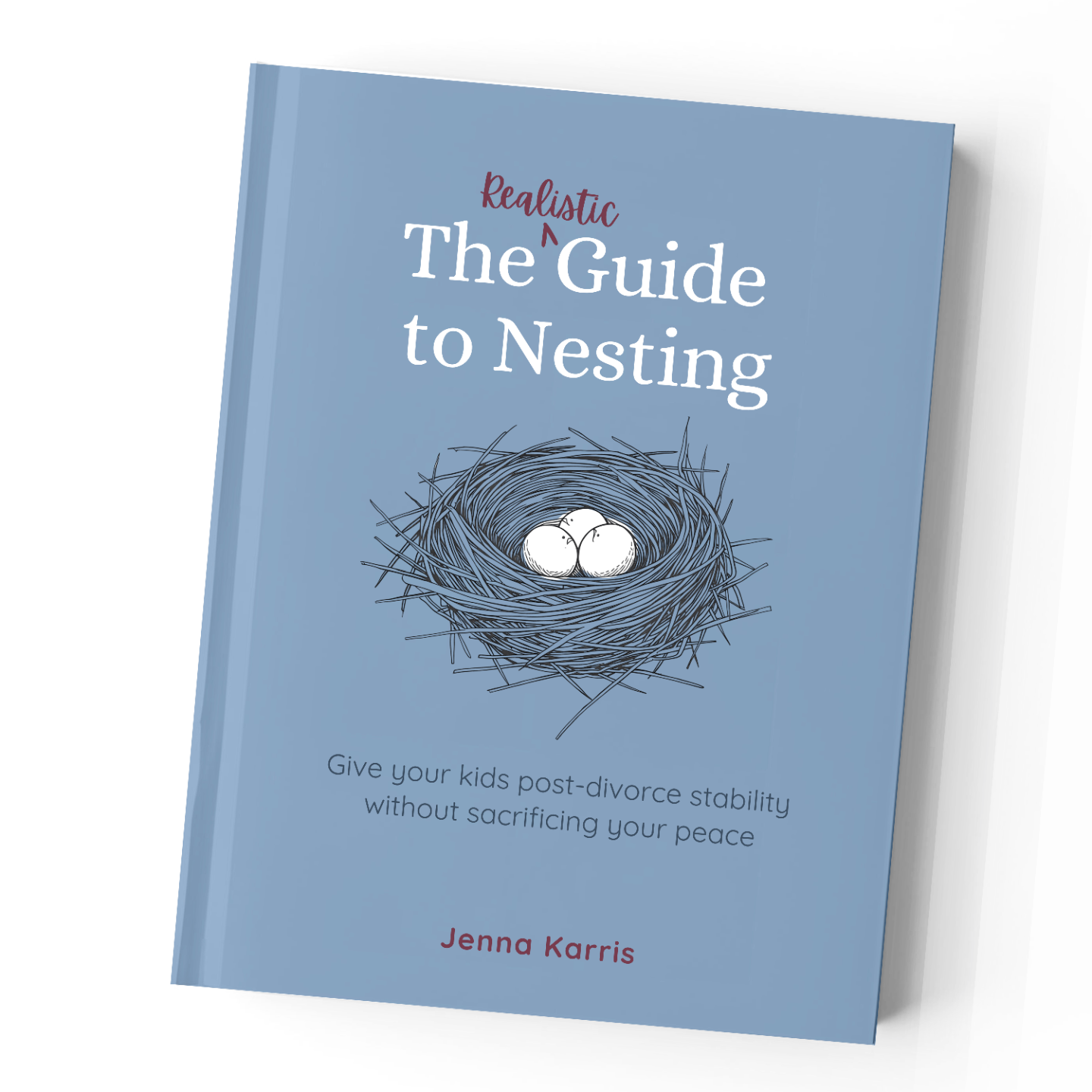
You don't have to choose between dissolving your marriage and keeping your kids' lives intact. Nesting flips the script. Your kids stay in one home, and you and your co-parent take turns staying with them. The adults handle the transitions while the kids stay grounded.
A gentler, stabler living arrangement after divorce is possible for your kids—even if you and your ex aren’t on the greatest terms.
Get the GUIDE
You can create a post-divorce life where...
-
You minimize the stress, upheaval, and disruption to you children's lives, and simplify your life in the process.
-
By giving your kids stability you actually give yourself more freedom and flexibility than would be possible in a two-home living arrangement.
-
You share the load of maintaining a household with your ex-spouse, without recreating the conflict that arouse when you were fully living together.
-
You do all this for less than the cost of two full-sized family homes!
If you search for advice on “nesting” in the divorce forums, you will find warnings from other divorcing co-parents who think the idea is downright bonkers. A common refrain is: “If my ex and I were able to coordinate and get along well enough to pull it off, we wouldn’t be getting divorced in the first place.”
So I understand the trepidation! If I had gone straight from separating into nesting, like most standard approaches to nesting suggest, I would have crashed and burned like some many other well-intentioned co-parents who have tried giving it a shot, only to have it end in disaster.
Many people nest to try and save the family home and maintain maximum stability for their kids, so they start nesting right away. But that doesn’t allow for much needed time and space required to heal, establish independence, and rebuild a different co-parenting relationship with your ex spouse. And not selling the family home keeps shared assets entangled and prevents co-parents from being able to re-establish financial independence.
Most divorcing couples need intentional time and space for healing, and a much needed reset on dysfunctional dynamics before attempting to navigate this transition, but the standard "straight into nesting" approach makes that challenging.
If the straight into nesting approach sounds viable to you and your co-parent, that’s wonderful! The guide will walk you through everything you need to align with your co-parent on how to move forward. But if the straight into nesting approach sounds like a disaster in the making, I can help you see the many alternative approaches you can take to transition to nesting on a timeline and in a format that actually makes sense for you and your family. You can live separately for a time and come back to nest on stronger footing. And you can sell your home, cash out the equity, and then still nest.
The critics are right about some things though—nesting isn't for everyone. It requires a level of respectful collaboration that many co-parents can't sustain, and that's okay. But if you're reading this guide, that means you’re already questioning the standard divorce playbook that says kids must bear the burden of shuttling between two worlds while the adults build stable lives and homes for themselves.
This guide can help take you through the next steps.
What I've learned through my own nesting journey is that it's less about the logistics and more about the willingness to reimagine what's possible. You can challenge yourselves to build something better than the default divorce template, and give your kids the gift of stability while you navigate the hard stuff on their behalf. You’ll be grateful you did, because the growth you experience to get to the other side is worth it in the end.
-Jenna
Why nesting is great for kids:
Traditional Two Home
X "Mom's house" and "Dad's house"
X Transition day anxiety and stress
X Packing and unpacking every week
X Two bedrooms, neither feels quite like theirs
X Belongings split between two homes
X Need duplicates of essential items
X Cats, fish, or hamsters get left behind
X Two neighborhoods or sets of friends
Nesting approach
✔ "My house"
✔ Always rooted in one place
✔ No packing stress or logistics for the kids
✔ One room that feels like their own
✔ All belongings always accessible
✔ One drum set, one bicycle, one swing set...
✔ Family pets always close by
✔ One community
...And why it's great for parents, too:
Traditional Two Home
X Two fully-equipped homes to maintain
X Kid areas of home are unused half the time
X Ex's stability directly impacts kids' stability
X Lack of alignment or visibility into other home
X Both homes must be near the school
X New partners enter and exit your kids' space
Nesting approach
✔ One family home + simpler adult spaces
✔ Maximize space in your adult home
✔ Confidence knowing kids have a stable home
✔ Know what kids are eating, wearing, etc.
✔ Freedom to live wherever during free time
✔ Dating life stays separate from kids' home
"We're already living separately—can we still transition into nesting?"
"Can we do this even if we aren't getting along very well right now?"
"We have to sell the house to disentangle financially—can we still nest even if we sell?"
Yes, yes, and yes!
You don't need to be at the beginning of your separation journey—in fact, it's often better when you've had time apart for you both to heal, establish independent routines, and break old patterns. You can transition into nesting anytime by converting one existing home into the nest, or getting a new nest entirely and either keeping or downsizing the adult homes.
You don't need to be best friends with your ex (your divorcing for a reason, after all!) in order to be able to align on how nesting affords many benefits to the kids (and parents), which is often motivation enough to work together through the initial logistics. Once you are up and running with nesting, you can do it with little to no interaction with your co-parent, if that's what you prefer, but you might also appreciate the closer contact nesting can afford you if you find your relationship softens and improves over time.
You don't need to keep your existing home. In fact, it's often more financially feasible to rent a smaller home since the parent's belongings aren't taking up space anymore. Use the equity from the home sale to establish the smaller adult homes and provide a financial cushion for the beginning of your new separate lives.
This guide is for you if:
- You’re navigating (or have already completed) a separation or divorce with kids involved.
- You want to minimize disruption to their routines and sense of home as you transition into separation—or you want to restore stability into their already split-living arrangement.
- You’re not ready (or able) to fully split households yet.
- You want to avoid unnecessary conflict, drama, and resentment.
- You want a realistic, emotionally grounded approach to nesting that still allows time and space for healing, establishing independence, and breaking out of old patterns.
What’s Inside:
- An introduction to nesting, including common configurations and transition plans
- How kids benefit (and how parents actually benefit, too)
- The reasons why "straight to nesting" approaches often crash and burn
- Self-reflections to do before nesting to ensure you're set up for success
- The detailed 7-step Nesting Planning Guide (for co-parents), including transition planning, budget worksheets, agreement templates and more
- Quick Conversation Guide (for the kids)
- Frequently asked questions
Meet Jenna
I was a parent just like you—wanting to do whatever I could for my kids, but also recognizing that my ex and I both needed time and space to heal from the ending of our marriage.
I held true to my vision for nesting while we were first living separating, even when my ex wasn't on board at first. Slowly, he came around once he realized it could be more affordable and would allow more freedom flexibility for both of us as parents. Now we co-parent peacefully, and our boys have one stable home.
I'm here to show other parents what's possible and to offer hands-on support for those who need it. Navigating any major life transition can stir up old wounds and shadows we didn't know were there. I'm an expert at helping you integrate those parts and come back to a feeling of wholeness and sovereignty on the other side.