Substack

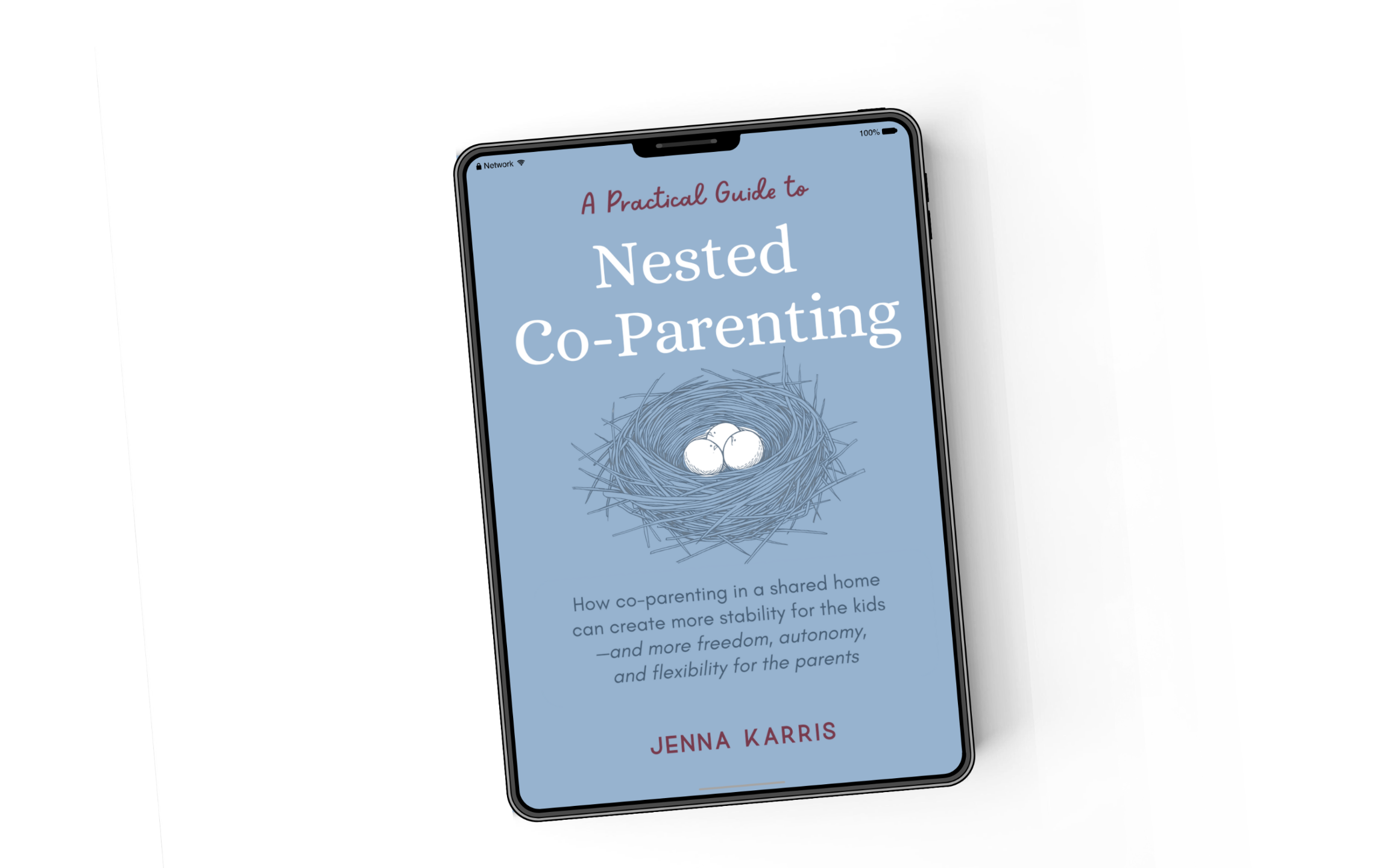
A Practical Guide to

Nested Co-Parenting 

How co-parenting in a shared home can create more stability for kids—and more freedom, flexibility, and autonomy for divorced parents

AVAILABLE NOW!

PDF - $14.95

Your kids didn't ask to split their lives across two homes.

But that's what conventional divorce requires of them. A childhood spent packing and unpacking, forgetting their homework or favorite stuffed animal at the other house, splitting their clothes, books, and toys across two bedrooms, two homes, two neighborhoods or two communities. It's friends asking, "Which house are you at this weekend? Oh, yeah... never mind."

The hidden cost of divorce isn't the legal fees or the divided assets—it's your kid's stability and peace of mind.

But what's the alternative? If staying married for the kids were an option, you'd do it. But you can't. The relationship has run its course. You and your ex both need to break out of dysfunctional patterns, need your own space, need to heal, and need to rebuild your lives. 

You don't have to choose between dissolving your marriage and keeping your kids' lives intact. Nesting flips the script. Your kids stay in one home, and you and your co-parent take turns staying with them. The adults handle the transitions while the kids stay grounded.   


What if your kids didn't have to split their lives after divorce? And what if giving them that stability also gave you more freedom and flexibility—not less?


A Practical Guide to Nested Co-Parenting challenges the standard divorce playbook that says children must bear the burden of continuously splitting their lives across two worlds after a divorce while the adults get to build stable lives for themselves.

Most people assume nesting means sacrificing your space, your healing, or your peace—but the opposite is true. When your kids have one stable home, you're free to live however and wherever you want without being tethered to an expensive school district. You can move in with a new partner without forcing your kids into a step-family dynamic. You can feel at ease knowing your children are safe and stable, no matter what's happening in your co-parent's personal life. And you can often do it all for less than the cost of maintaining two family-sized households in an expensive school district.

We're so conditioned by the conventional divorce narrative—and so eager to get as far away from our ex's as possible—that we miss the opportunity for a creative living solution that's actually better for everyone in the long run.

And what little conventional advice exists around nesting sets most families up to fail. The standard approach to nesting skips the emotional groundwork, rushes the transition, and leaves co-parents white-knuckling through an arrangement that prevents them from moving on. This guide walks you through the common pitfalls that derail most nesting attempts and offers a better path, one that leads to sustainable, long-term living stability for everyone involved—even if you and your ex aren't on the greatest terms.

Includes:

  • 7-step Nesting Planning Guide for co-parents—including worksheets for designing your nest, shared budgets, and co-parenting agreements
  • Conversation Guide for talking to your kids about nesting
  • Reflection exercises and crucial inner work to address through before attempting to nest
  • FAQs addressing common questions and concerns

You can create a post-divorce life where...

  • You minimize the stress, upheaval, and disruption to you children's lives, and simplify your life in the process.

  • By giving your kids stability you actually give yourself more freedom and flexibility than would be possible in a two-home living arrangement.  

  • You share the load of maintaining a household with your ex-spouse, without recreating the conflict that arouse when you were fully living together.

  • You do all this for less than the cost of two full-sized family homes!


If you search for advice on “nesting” in the divorce forums, you will find warnings from other divorcing co-parents who think the idea is downright bonkers. A common refrain is: “If my ex and I were able to coordinate and get along well enough to pull it off, we wouldn’t be getting divorced in the first place.”

So I understand the trepidation! If I had gone straight from separating into nesting, like most standard approaches to nesting suggest, I would have crashed and burned like some many other well-intentioned co-parents who have tried giving it a shot, only to have it end in disaster.

Many people nest to try and save the family home and maintain maximum stability for their kids, so they start nesting right away. But that doesn’t allow for much needed time and space required to heal, establish independence, and rebuild a different co-parenting relationship with your ex spouse. And not selling the family home keeps shared assets entangled and prevents co-parents from being able to re-establish financial independence.

Most divorcing couples need intentional time and space for healing, and a much needed reset on dysfunctional dynamics before attempting to navigate this transition, but the standard "straight into nesting" approach makes that needlessly challenging—often to the point of being impossible.

If the straight into nesting approach sounds viable to you and your co-parent, that’s wonderful! The guide will still walk you through everything you need to align with your co-parent on how to move forward. But if the straight into nesting approach sounds like a disaster in the making, I can help you see the many alternative approaches you can take to transition to nesting on a timeline and in a format that actually makes sense for you and your family. You can live separately for a time and come back to nest on stronger footing. And you can sell your home, cash out the equity, and still nest afterwards. 

The haters are right about some things though—nesting isn't for everyone. It requires a level of respectful collaboration that many co-parents can't sustain, and that's okay. But if you're reading this guide, that means you’re already questioning the standard divorce playbook that says kids must bear the burden of shuttling between two worlds while the adults build stable lives and homes for themselves. 

This guide can help take you through the next steps.

Get the GUIDE

"Through nesting, you can challenge yourselves to build something better than the default divorce template, and give your kids the gift of stability while you navigate the hard stuff on their behalf. You’ll be grateful you did, because the growth you experience to get to the other side is worth it in the end."

-Jenna

Why nesting is great for kids:

Traditional Two Home

X "Mom's house" and "Dad's house"

X Transition day anxiety and stress

X Packing and unpacking every week

X Two bedrooms, neither feels quite like theirs

X Belongings split between two homes

X Need duplicates of essential items

X Cats, fish, or hamsters get left behind

X Two neighborhoods or sets of friends

Nesting approach

 "My house"

 Always rooted in one place

 No packing stress or logistics for the kids

 One room that feels like their own

 All belongings always accessible

 One drum set, one bicycle, one swing set...

 Family pets always close by

  One community

...and why it's great for parents, too:

Traditional Two Home

X Two fully-equipped homes to maintain

X Kid areas of home are unused half the time

X Ex's stability directly impacts kids' stability

X Lack of alignment or visibility into other home

X Both homes must be near the school

X New partners enter and exit your kids' space

Nesting approach

 One family home + simpler adult spaces

 Maximize space in your adult home

 Confidence knowing kids have a stable home

 Know what kids are eating, wearing, etc.

 Freedom to live wherever during free time

 Dating life stays separate from kids' home

"We're already living separately—can we still transition into nesting?"
"Can we do this even if we aren't getting along very well right now?"
"We have to sell the house to disentangle financially—can we still nest after we sell?"

Yes, yes, and yes!


You don't need to be at the beginning of your separation journey—in fact, it's often better when you've had time apart for you both to heal, establish independent routines, and break old patterns. You can transition into nesting anytime by converting one existing home into the nest, or getting a new nest entirely and either keeping or downsizing the adult homes.

You don't need to be best friends with your ex (your divorcing for a reason, after all!) in order to be able to align on how nesting affords many benefits to the kids (and parents), which is often motivation enough to work together through the initial logistics. Once you are up and running with nesting, you can do it with little to no interaction with your co-parent, if that's what you prefer, but you might also appreciate the closer contact nesting can afford you if you find your relationship softens and improves over time.

You don't need to keep your existing home. In fact, it's often more financially feasible to rent a smaller home since the parent's belongings aren't taking up space anymore. Use the equity from the home sale to establish the smaller adult homes and provide a financial cushion for the beginning of your new separate lives.

Get the GUIDE


Want more high-touch support?

Fill out INTEREST FORM

This container is for you if...

  • You are tired of feeling stuck in a less-than-satisfying co-parenting dynamic or two-household living arrangement.

  •  You are committed to centering your children in your co-parenting strategies.

  •   You are committed to looking inward at the role you've been playing in your patterns, and you are ready to stop directing your energy towards getting your co-parent to change. 

  • You want support for both you and your co-parent—but it is completely fine to embark on this work solo even if your co-parent isn't interested in participating.

The hardest part of co-parenting isn't the logistics
it's the murky emotional stuff underneath 

 You know what you're supposed to do—stay calm, hold boundaries, keep the focus on the kids. But knowing what to do and actually being able to do it in the moment are two different things, especially when interactions with your co-parent still have the potential to pull you back into the old dysfunctional relational patterns. This work is for you, whether you're navigating a transition into nesting, managing challenging dynamics with a co-parent, or grappling with your new identity as a co-parent and part-time single person.

This is that deeper work.

This work is for you, whether you're navigating a transition into nesting, managing challenging dynamics with a co-parent, or grappling with your new identity as a co-parent and part-time single person.

I help people navigate the emotional layers that underpin the logistical aspects of separation, nesting, and co-parenting. We get clear on what's really driving the tension that's preventing smoother collaboration, dig into the shadow parts that keep you reactive, and build new ways of relating that don't require your co-parent to change first.  


This is not couples' counseling

The joint sessions I offer to co-parents are for discussing logistics only—agreeing on a nesting configuration, drafting agreements, and aligning on a co-parenting strategy. This is not a space for rehashing grievances or staging arguments—the messy, unmasked emotional work is reserved for the individual sessions where it's easier and safer to unpack what might be going on underneath the surface, without your ex in the audience. Both co-parents are welcome to see me individually, but it's also totally okay for only one parent to do the individual sessions and for the other co-parent to participate only in the joint sessions, or not at all. 

Joint sessions are for co-parents who are ready to collaborate on:

  • Aligning on logistics, schedules, and agreements
  • Future visioning—what does this look like long-term?
  • Navigating transitions (into nesting, out of nesting, handling new partners, moves)

Individual sessions are for deeper work on triggers and shadow parts:

  • Getting curious about whatever is coming up emotionally 
  • Unpacking your subconscious contribution to the patterns in the dynamic
  • Communication strategies that account for what's being said between the words—managing and navigating the energetic layer to communication
  • Building boundaries that are rooted in sovereignty, not defensiveness 
  • Moving from triggered reactivity to grounded sovereignty

It is very common, especially in higher-conflict separations, for a narrative to take root that one person is the perpetrator of the dysfunction and the other is just on the receiving end of it. Oftentimes, each partner is telling themselves an inverse version of this same story since both people feel invalidated, controlled, manipulated, or gaslit at the same time.

When I work with ex-partners individually, I do not seek to get to the bottom of who is more "right". I believe that whatever experience you're having with your ex-partner is completely real, true and valid—to you. But I also believe, it is completely within your control to change your experience of it.

Behind every claim that the other person is projecting something onto you, is a seed of fear that what they are saying might be true. Behind every claim of gaslighting or manipulation is a seed of self-abandonment. Together, we can shift the focus away from whatever our ex is doing back onto ourselves and how we are receiving it. How are we overstepping or abandoning our own sovereignty? How are we still looking for this other person for the feelings of worthiness or validation that we should be sourcing from within?

If both partners are willing to authentically and vulnerably engage in this type of work, the shift can be immense, but even if only one of you has the capacity to dive this deep, an individual in the relationship still has the power to radically shift the dynamic. 


Each package is customized depending on the level of support required, starting with a $3,000 retainer for a minimum of 3-months—though the transformation work will certainly take longer than that! You can either extend or come back for periodic boosts along the way—I trust you to know when and how much support you need during your journey.

I provide flexible containers that can look like high-intensity support for shorter periods of time (several hours-long sessions over the course of a few weeks) or more spread out, periodic support over many months. We can feel into what feels right!

  • Coaching sessions, intuitive readings and instruction, and shadow parts work ($200/hr)
  • Deep dive (3+ hrs) sessions as needed ($200/hr)
  • Unlimited async text, voice memo and video memo support as needed (included)
  • Recommended additional resources and healing modality as needed

I take on a handful of 1:1 clients at a time so that I can focus my time and energy on guiding each person with the care and attention they each require.

Please fill out this intake form and I'll get back to you in a few days to let you know if it feels aligned.

Coaching Interest Form


Want to dive

even deeper?

I lead a series of Integration Circles to help guide you through the shadow work I lay out in my books. I use my very own Three-Level Spiral Healing Framework to help you identify the shadows that have been secretly running the show in your relationships and in the other arenas of your life.

If you're ready to feel liberated to lean into relationships with an open heart, without that lingering fear that you'll just get sucked into the same patterns again and again—this is the space for you.

Integration Circles are for you if...

  • You've done the work to bring self-awareness to your patterns in your co-parenting dynamic and you are ready to dig into the deeper shadow work so you can avoid getting sucked back into them.
  • You want to heal yourself by being supportive to others (which is actually one of the best ways to uncover your own hidden shadows!)
  • You want to learn how to tune into and trust your own intuitive inner knowing so you stop feeling confused or ungrounded.
  • You want to practice what it feels  and looks like to stand in your own sovereignty in your co-parenting relationship—and what it means to respect and honor your co-parent's sovereignty in return.
  • You want to practice accessible mediation, grounding and intuitive exercises you can bring into your everyday life.

The Circles are ongoing and are designed so that you can join in anytime, and you will benefit from the balance between consistency as well as fresh faces in your group. 

They are available in 3-month packages, which you can renew as many times as you like—you'll keep practicing the same basic techniques but with new context each session so no two sessions will ever be the same. The sessions require a one-month 1:1 onboarding experience first, which you can sign up for below. 

What's included:

  • 3 months of bi-weekly 90-min group integration sessions in groups of 4-6 people
  • 3 months of bi-weekly office hours where you can sign up or drop in for 15-min of 1:1 support 
  • Text, voice memo and video message support (unlimited)
  • Guided exercises for further integration between sessions, tailored to each group

Investment:

  • $250 for the initial 1:1 onboarding session + 1 month text support
  • $1500 for each 3-month package of Integration Circle sessions + text support + 1:1 office hours


Guided Course

Beginning SUMMER 2026!


The guided course for Nested Co-Parenting will become available this Spring, and will include:

  • Weekly video modules
  • Weekly reflection questions & exercises
  • Monthly live Q&A sessions.
  • Option to join a "study group" of your peers for additional support 

PRE-REGISTER for a discounted rate of $97—the launch price goes up to $197.

PRE-REGISTER NOW

Do you have a story for Jenna?

I am always eager to learn from the experiences of fellow travelers through life. If you have a story, insight, or experience that could inform my writing, please share it with me by filling out the form below 🙏

Sign up for Jenna's Newsletter

For inspirational content and sneak peaks and exclusive discounts on upcoming books, courses & offerings